No products in the cart.
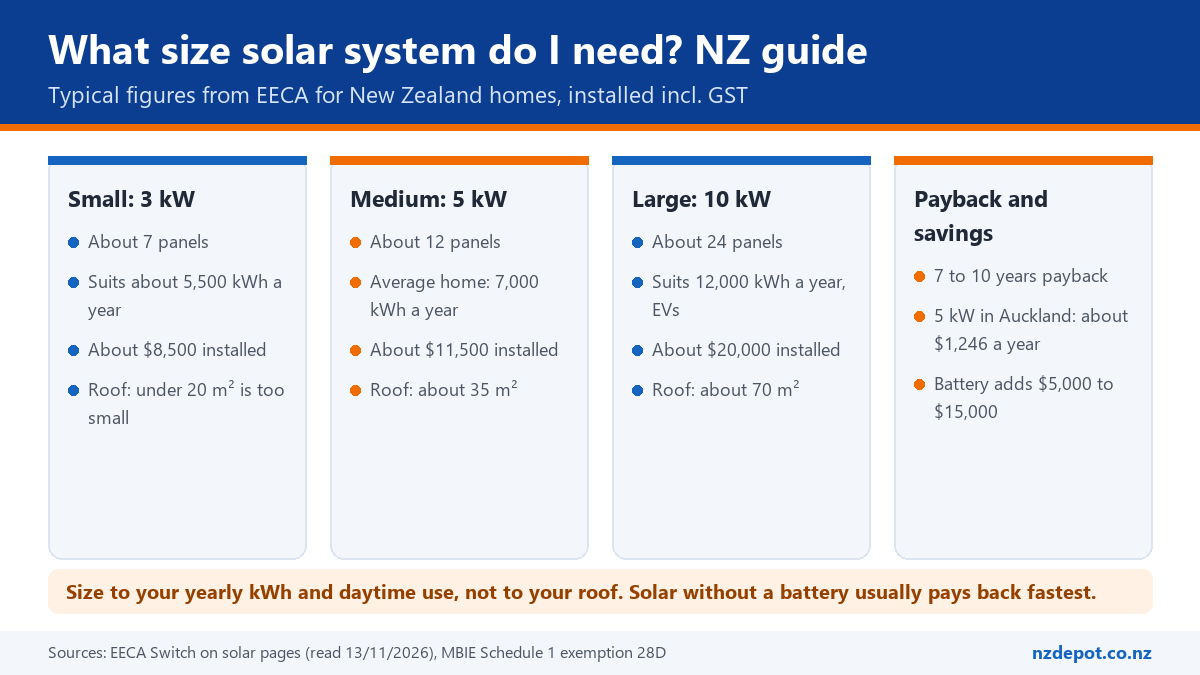
What size solar system do I need? For most New Zealand homes the answer is 3 to 5 kW. EECA says a system that size makes around 50 to 80% of the electricity an average three person, all electric home uses, and it puts typical installed prices at $8,500 for 3 kW and $11,500 for 5 kW. Bigger homes, EVs and night-time use push you towards 10 kW.
Quick answer
- Start with your power bill. The average NZ home uses about 7,000 kWh a year, and EECA says that lines up with a medium (5 kW) system.
- 3 kW (about 7 panels) suits low use, around 5,500 kWh a year. 5 kW (about 12 panels) suits most families. 10 kW (about 24 panels) suits 12,000 kWh a year or more.
- Roof space: about 35 m² for 5 kW and 70 m² for 10 kW. Under 20 m² is too small for 3 kW.
- Payback: 7 to 10 years if you use most of the power during the day. A battery adds $5,000 to $15,000 and usually stretches that out.
What size solar system do I need for my home?
Size the system to the electricity you actually use, not to the size of your roof. EECA is clear on this: a system larger than you need will not be cost effective, and one that is too small leaves savings on the table. Your power company’s app or website shows your yearly kWh, and most also show what time of day you use it. That second number matters because panels only produce in daylight.
EECA works through three example homes on its planning page. They are a good shortcut if your house looks like one of them.
| EECA example home | Power use a year | System | Installed cost (EECA) | Savings a year |
|---|---|---|---|---|
| 2 people, Wellington city, often home in the day | 5,500 kWh | 7 panels, 3.5 kW, 3 kW inverter, no battery | $9,000 | $1,500 |
| 4 people, suburban Auckland, often home in the day | 8,000 kWh | 12 panels, 5.5 kW, 5 kW inverter, no battery | $12,000 | $1,500 |
| 5 people, rural Christchurch, rarely home in the day, has an EV | 12,000 kWh | 24 panels, 10 kW, 9 kW inverter, 10 kWh battery | $30,000 | $1,500 |
Notice the savings column. All three homes save about the same, even though the big system costs more than three times as much. The large home is out during the day, so it needs a battery to use its own power, and that is where the extra money goes. If you are home in the day, a smaller system without a battery usually pays back faster.
Plan for the next few years too. An EV, a spa pool or more people in the house all raise the right size, so mention them to your installer before the design is locked in.
How many panels make 3, 5 or 10 kW?
System size is the total rated power of the panels. EECA’s own example is 13 panels at 400 W each, which gives 5,200 W, or 5.2 kW. Today’s roof panels are larger, so the count drops: 12 panels at 460 W come to 5.52 kW, and 8 panels at 650 W make 5.2 kW.
The inverter is the box that turns the panels’ DC power into AC for the house. EECA says it should be equal to or a little smaller than the panel total, and that about 20% more panel capacity than inverter capacity tends to give the best value for most NZ homes. Panels rarely run at full output, so the inverter only caps them for short spells on the sunniest summer days. That is why you will see kits such as 5.5 kW of panels on a 5 kW inverter.
Check one more thing before you look at a 10 kW kit: whether your home is single phase or three phase. Some larger inverters, including the one in our 26 panel kit, are three phase, and a three phase inverter needs a three phase supply. Your electrician can check this at the switchboard.
Is your roof big enough?
EECA gives these roof guides. Each panel is usually 1.6 to 2 m², and a small to medium system needs room for at least 7 to 12 of them.
- Space: 70 m² allows up to 10 kW, 35 m² up to 5 kW, and less than 20 m² is too small for 3 kW. Higher efficiency panels make more power per square metre but cost more.
- Direction: north, north-east or north-west is ideal. East or west is good. South facing is poor.
- Tilt: 30° to 45° gives the most power, 15° to 30° is fine. Flat roofs need racks, which add cost.
- Condition: if the roof needs replacing or major work within 10 years, do that first. Taking panels off and putting them back is a cost you can avoid.
- Shade: a little shade early or late in the day is fine. Lots of shade during the day is a problem, and microinverters, one per panel, can help where some panels are shaded.
Building consent is usually not needed. Since October 2025, Schedule 1 of the Building Act (exemption 28D) covers roof arrays of up to 40 m² on each independent roof structure, as long as the wind zone is no higher than “high”. MBIE’s guidance also says to keep arrays at least 600 mm from roof edges and gutters. Bigger arrays, or very windy sites, need a Chartered Professional Engineer. A 10 kW system is roughly at the 40 m² line on a single roof, so ask your installer to measure it.
Solar cost and payback in NZ
These are EECA’s typical installed prices, including standard installation and GST. Use them to sense-check quotes.
| System | Panels | Without battery | With battery |
|---|---|---|---|
| Small, 3 kW | 7 | $8,500 | $13,500 (5 kWh battery) |
| Medium, 5 kW | 12 | $11,500 | $21,500 (10 kWh battery) |
| Large, 10 kW | 24 | $20,000 | $40,000 (20 kWh battery) |
On savings, EECA estimates that a 5 kW system in a home with electric heating and hot water saves about $1,246 a year in Auckland, $1,129 in Wellington, $1,180 in Canterbury and $1,467 in Marlborough (December 2025 figures for the main city in each region). Its typical payback is 7 to 10 years when the household uses most of what the panels make. The shortest paybacks are around 7 to 8 years, and some homes take 10 to 12.
Three things shorten payback the most:
- Use the power in daylight. Run the washing machine, dishwasher and oven while the sun is out, and charge an EV during the day.
- Heat water with solar. A timer or solar diverter on an electric cylinder is a low cost add-on in every EECA example. Our hot water heat pump guide covers the other route.
- Pick the right power plan. EECA suggests a flat rate plan without a battery and a time-of-use plan with one. The buyback rate for exported power is lower than what you pay for mains power, and it varies a lot between retailers.
Panels last 25 to 30 years with only about 0.5% less output each year, according to EECA. The inverter will likely need replacing after 10 to 15 years, so allow for one replacement in your sums.
Do you need a battery?
Not to start with. EECA says solar without a battery generally gives the best returns, and many homes add one later. A battery makes sense when most of your use is at night and cannot be moved, or when you want power during an outage. For that you also need a backup-capable inverter, because a system without a battery gives no power in a power cut. If you might add one later, say so when you get quotes: EECA notes that the inverter choice can affect the cost of adding a battery later. Our solar batteries range shows current options.
What a good quote should include
Get 2 or 3 quotes from installers who visit the house, as EECA suggests. Each quote should list scaffolding or edge protection, all components including cabling, racking and surge protection, roof work, consents, inspections, any network upgrade and the import/export meter. EECA’s minimum warranties to ask for are 5 years on workmanship, 10 years on the panel product, 5 years on a string inverter, 10 years on microinverters and 10 years on a lithium battery.
Your installer also lodges a distributed generation application with your lines company. For a system under 10 kW, EECA says this is usually quick and cheap, and approval generally takes 1 to 2 weeks. The meter then has to be set up for two-way metering before you can sell power back.
Solar panels and kits at NZ DEPOT
We sell panels and complete grid-tied kits supply only, for your registered electrician or solar installer to fit. On 13/11/2026 our prices, incl. GST, were $3,279.99 for a 7 panel kit (7 JA Solar 460 W panels, 3.22 kW, with a 3.6 kW grid-tied inverter), $4,609.99 for a 12 panel kit (5.52 kW of panels on a 5 kW single phase inverter) and $8,829.99 for a 26 panel kit with about 12 kW of panels and a 10 kW three phase inverter. Single LONGi 650 W panels were $269.99 each. Installation is not included, and delivery is usually 3 to 9 working days. The grid below shows live prices and stock.
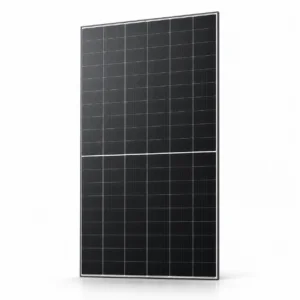
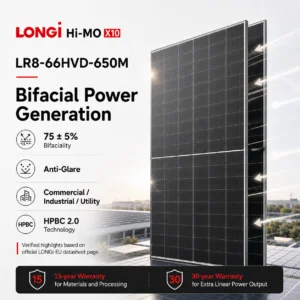
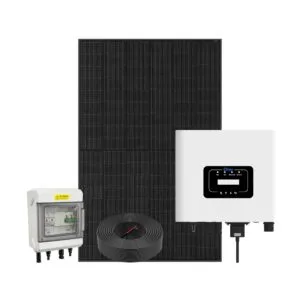
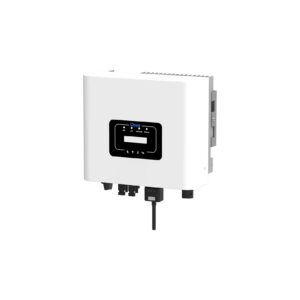
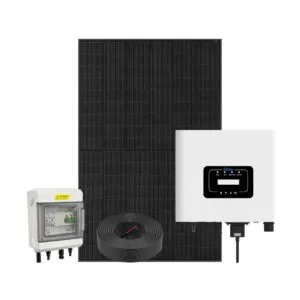
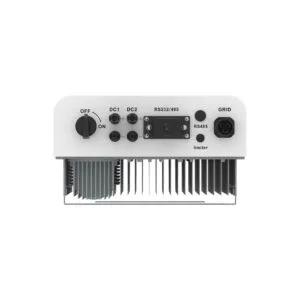
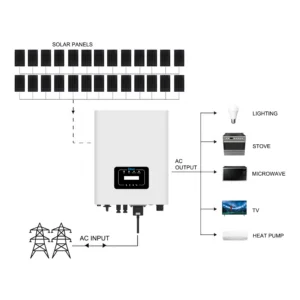
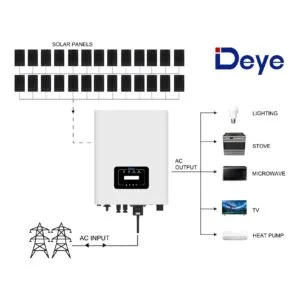
Browse all solar panels or the grid-tied solar kits, or send us your yearly kWh and roof size and we will suggest a kit.
Solar system size FAQs
Is a 10 kW solar system too big for a house in NZ?
For many homes, yes. EECA’s 10 kW example uses 12,000 kWh a year, has an EV and includes a battery. If you use around 7,000 kWh, a 5 kW system is the closer match, and a bigger one sends more of its power to the grid at the lower buyback rate.
How many solar panels do I need for a 5 kW system?
About 12 panels at 400 to 460 W, or 8 panels at 650 W. EECA’s medium system is 12 panels.
How much roof space does a 5 kW system need?
EECA says about 35 m². Each panel is usually 1.6 to 2 m².
Do I need a building consent for solar panels?
Usually not. Roof arrays up to 40 m² on each independent roof structure are exempt under Schedule 1 (exemption 28D), if the wind zone is no higher than high. The work must still meet the Building Code.
Is solar worth it in Auckland?
EECA estimates a 5 kW system saves about $1,246 a year at an Auckland address, for a home with electric heating and hot water. With an installed cost of around $11,500, that is in line with EECA’s 7 to 10 year payback.
Does solar add value to my house?
EECA cites a 2025 New Zealand study that found homes with solar sold for an average premium of 1.34%.
Related guides and products
Sources
- EECA, Solar costs and savings (read 13/11/2026; savings calculated December 2025)
- EECA, Plan your solar system (read 13/11/2026)
- EECA, Is solar right for your home? (read 13/11/2026)
- EECA, Learn about solar technology (read 13/11/2026)
- EECA, Solar quotes and installation (read 13/11/2026)
- EECA, Make the most of your solar system (read 13/11/2026)
- MBIE Building Performance, 14.3 Roof-mounted solar panel arrays of less than 40 m² (archive copy of 14/03/2026)
- NZ DEPOT catalogue prices on 13/11/2026 (the product grid above is live).